


[AD] My Thoughts on Tempdrop [Tempdrop Review, Tempdrop Vs Lady-Comp + My Honest Thoughts]
This content includes advertisement and affiliate links. To read the full policy on this, click here.

In this post:
Introduction
I have already written a lengthy discussion about Tempdrop in the past but I wanted to revisit and write a more concise version.
What is Tempdrop?
I purchased a Tempdrop when it was quite new to the market (October 2017). Tempdrop is a wearable thermometer designed for those using a fertility awareness-based method (FABM). It is worn on the inside of the upper arm, secured by a strap. The device is then turned on before you go to sleep (by pressing a button) and automatically shuts off when you remove it the next morning. You can then sync your temperature reading into the Tempdrop app.


How Is Tempdrop Different From Other Femtech? – Tempdrop vs Lady-Comp
Over the several years I have practiced fertility awareness, I have been lucky enough to try out several different devices. My current staples are Lady-Comp and Tempdrop. You can read more about Lady-Comp in my full review here but, in short, it is a device that is a method in itself. When a temperature reading is taken, it displays a traffic light system to signal what the fertility status is for the given day. By contrast, Tempdrop is simply a tool where you apply the rules of your method independently to decide your own fertility status. With Lady-Comp, temperatures need to be taken manually while Tempdrop automatically works during sleep.
In my opinion, both devices have a place in our world as everyone’s wants and needs are unique when it comes to managing fertility. I personally choose to use both as I enjoy collecting as much data as possible about my cycle, however, I do not rely on Lady-Comp’s lights as I follow the NFPTA method which requires my own analysis.
To show you the difference between temperatures generated via Tempdrop or those taken vaginally using another thermometer, I made the below graph.
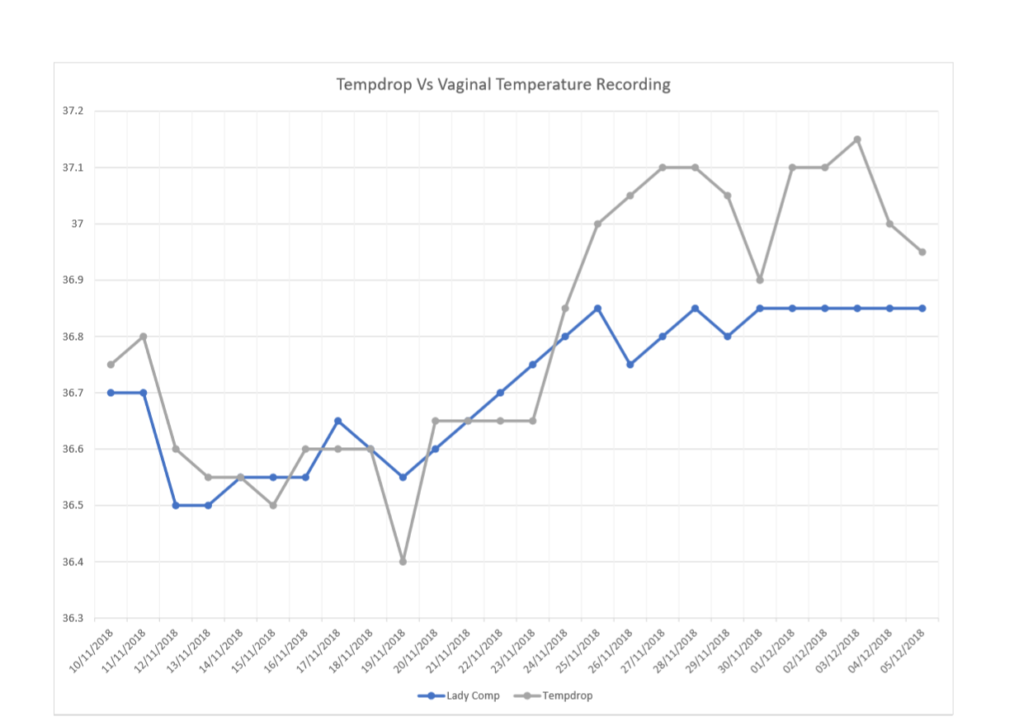
I’ve chosen not to mark this chart up with a coverline, temp count or give any indication of cervical fluid analysis here, simply because I don’t want to confuse anyone since there are many different methods of fertility charting/analysis, depending on which one you’ve learned. The key point here however, is that both temping methods clearly show a preovulatory and postovulatory temperature range.
As a side note, you’ll also notice that I used a Lady-Comp device to record my temperatures vaginally – this is something I have always done as I enjoy the way the device stores data and find the thermometer itself to be good quality. Using the device vaginally is not how it is intended to be used but is ok, as long as you factory reset the device before beginning to use it in this way and don’t alternate between that and oral temperatures (i.e if you’re using it vaginally, you need to keep using it this way unless you factory reset it again for the traffic light functions of it to be accurate).
Pros of Tempdrop
- Great for those with disturbed sleeping patterns – I personally have found the algorithm really good at filtering out times where I may have woken up briefly or had a restless night.
- Useful for parents where babies/children may wake them frequently at night. Taking temperature readings with a traditional thermometer can be difficult for new parents or those with young children. As Tempdrop automatically records, it eliminates the worry about remembering to temp when woken.
- Useful for shift workers who may not have a consistent sleep/wake schedule. Some smart devices on the market have a window of time where temperature readings must be taken. For shift workers, this would be difficult as they may work varying hours across any given week. Tempdrop is simply put on before sleep and turns off when removed rather than being sensitive to the time of day or night.
- Handy for those who don’t like to wake up and take their temperature manually.
- The Tempdrop app is able to integrate with other FABM apps which can be really useful
Cons of Tempdrop
- The algorithm has been slightly slower at times when compared with vaginal temping to confirm my shift (e.g. I will see my temperature rise 1-2 days later with Tempdrop compared with ‘manual’ temping). I’m not really sure why this is. It isn’t a massive problem to me but to others who want to confirm ovulation ASAP, this is something to be potentially aware of.
- Frame issues were common when I first began using my Tempdrop. Many people (including me) experienced a broken frame and were sent a replacement. However, Tempdrop has now switched to a fabric armband which has worked out really well for me.
- Changing the battery can be difficult. I would recommend consulting the battery changing guide carefully (within the Tempdrop app) to ensure the new battery goes in correctly without bending any part of the device casing. This issue has now been resolved since the release of Tempdrop 2.
Conclusion: My Overall Tempdrop Review
Personally, I love using Tempdrop, more so now that they switched to the fabric armband. I find the device comfortable, easy to use and it helps me to get that extra bit of data that could be the difference between being able to confirm ovulation or not. However, I do still hold the opinion that all new FAM users should at least try to temp manually first – not everyone needs a Tempdrop from day one and I’d generally put it in the category of a ‘nice to have luxury’ if you can afford it.
If you’re interested in purchasing a device, you can use my Tempdrop discount code SARAHC here.



“The algorithm has been slightly slower at times when compared with vaginal temping” — exactly what I found using TempDrop as well; glad to know it’s not just me who noticed. Thank you for sharing your voice & personal truths so transparently on your blog: the world needs it. Xx
Thank you for letting me know your experience, it’s really good to connect with another TD user! And thank you, means a lot to hear you say that 🙂 xx